Editor's note: We've seen wild swings in the market recently. And in today's environment, piling into seemingly "safe" stocks could be riskier than you might expect...
To that point, today we're sharing an updated version of a classic essay from Joe Austin on the subject. Longtime readers might recognize this essay. It first appeared in the October 4, 2024 edition of the Chaikin PowerFeed. But Joe's message is just as important today as ever...
Everyone is a "long-term investor"... until a stock heads south.
Then things get tricky. Does that mean you should buy more shares at the lower price? Sell the whole position? Or just sit there and stew on it?
When faced with a drawdown in a stock they own, investors are more likely to sell their winners and buy more of their losers. Psychologists call this the "disposition effect."
When we have a gain, we get greedy. And we want to lock it in.
But when we have a loss, we become hopeful. We're inclined to double down.
Famed investor Peter Lynch likened this to bad gardening. In his famous book, One Up on Wall Street, he said "selling your winners and holding your losers is like cutting the flowers and watering the weeds."
But when a stock goes down, we have to make decisions in a vacuum. No company is going to hold your hand... or give you a heads-up to sell.
And in that void, emotions take over.
So how can we make rational decisions? We have to listen to the market. And luckily, the Power Gauge is here to help...
For decades, "buy and hold" was gospel in investing.
Big names like Jack Bogle, Warren Buffett, and even Benjamin Graham all lived by it.
And it worked. Companies that did well one year tended to do well the next. And even if you were wrong, the market bailed you out. A strong market tended to lift weaker stocks.
But blindly following the "buy and hold" mantra can be dangerous.
A great example of this within the S&P 500 Index is food giant Kraft Heinz (KHC)...
Back in 2015, Kraft and Heinz merged to form one of the largest food companies in the world. Warren Buffett loves it. Berkshire Hathaway (BRK-B) still holds a roughly 27% stake in the company.
Kraft Heinz sells lots of brands we all know. For example, aside from its well-known namesake ones, it also owns brands like Maxwell House coffee, Oscar Mayer hot dogs, and Capri Sun juice.
Kraft Heinz is a household name. It makes products everyone recognizes. So you would think the business would be stable.
But that's not the case. Since the merger, the company has had huge problems.
First, it had too much debt. Then came healthy eating. Processed cheese and ketchup weren't part of that trend.
Now, many supermarkets are increasingly focused on private-label products. The stores own and sell these goods themselves.
Private labels are cheaper. And in today's cost-conscious world, consumers are going cheap.
When it comes to the stock, a look at the Power Gauge shows how the company's struggles have played out in recent years...
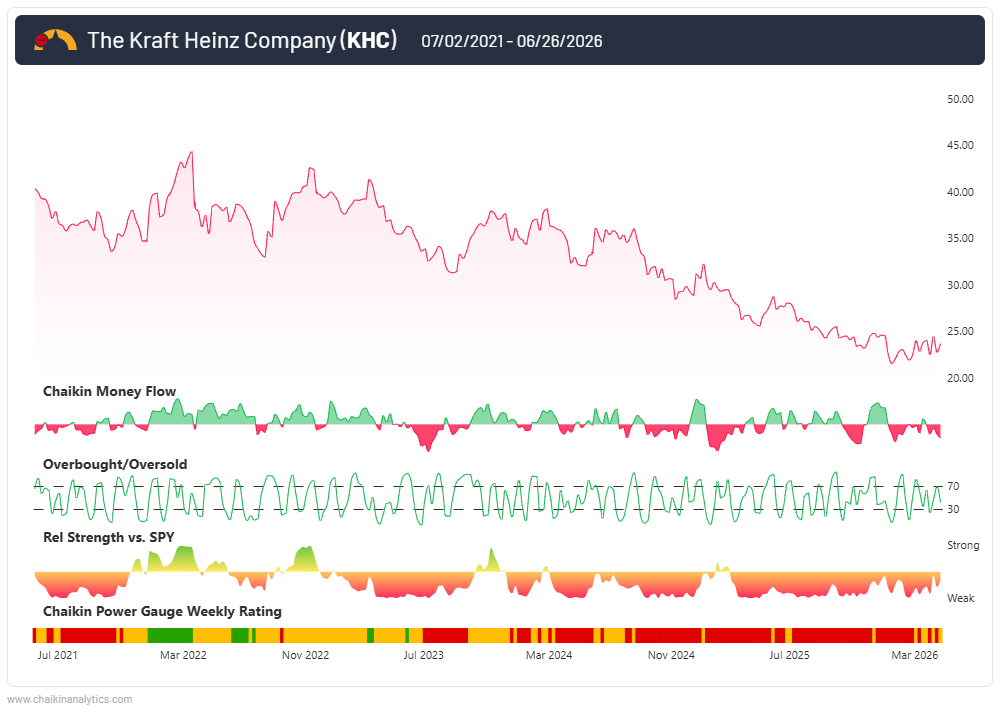
In short, things haven't looked so great over the past five years. As you can see, the stock has mostly languished in "neutral" or "bearish" territory in the Power Gauge. Right now, it has a "neutral-" rating.
As a reminder, this rating happens when a "bearish" or worse stock trades above its long-term trend line.
Meanwhile, Kraft Heinz's relative strength versus the S&P 500 has been weak overall. KHC shares have collapsed by about 40% over the past five years. And the broad market is up a whopping 73% over that same time frame. That's massive underperformance.
So, there's not much winning here for Kraft Heinz. But the company is far from alone when it comes to weak stocks in the S&P 500...
Based on the State Street SPDR S&P 500 Fund (SPY), the Power Gauge is "neutral" on the broad market right now.
To be clear, our system does give 116 holdings in SPY a "bullish" or better rating. But amid all those holdings with great ratings, the Power Gauge also sees 76 "bearish" or worse stocks.
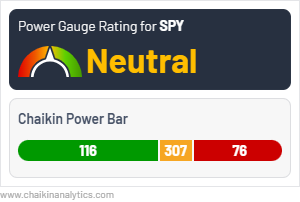
Put simply, it's not enough to dump money into a big-name company that seems "good" on the surface... and then hope for the best.
Today's market demands a more active approach to find the traps. "Buy and hold" just isn't working like it used to.
Good investing,
Joe Austin
Editor's note: With some stocks skyrocketing and others plunging, it's hard to know where to put your money to work...
As regular readers know, that's where the Power Gauge comes in. And now, we're delivering a transformative innovation for our one-of-a-kind system...
It's the first-ever AI-powered solution from our firm. And it's designed to help you find stocks with massive profit potential in a way that wasn't even possible before now.
Put simply, we've used AI to build our very own version of a stock market time machine.
Joe and our founder, Marc Chaikin, recently went on camera to share the full story – and how you can use it to find the next generation of potential 10x stocks. Get the details here before this presentation goes offline at midnight tonight.